AnchorWeave: World-Consistent Video Generation
with Retrieved Local Spatial Memories

1University of North Carolina, Chapel Hill 2NTU Singapore 3AI2

Abstract

Maintaining spatial world consistency over long horizons remains a central challenge for camera-controllable video generation. Existing memory-based approaches often condition generation on globally reconstructed 3D scenes by rendering anchor videos from the reconstructed geometry in the history. However, reconstructing a global 3D scene from multiple views inevitably introduces cross-view misalignment, as pose and depth estimation errors cause the same surfaces to be reconstructed at slightly different 3D locations across views. When fused, these inconsistencies accumulate into noisy geometry that contaminates the conditioning signals and degrades generation quality.

We introduce AnchorWeave, a memory-augmented video generation framework that replaces a single misaligned global memory with multiple clean local geometric memories and learns to reconcile their cross-view inconsistencies. To this end, AnchorWeave performs coverage-driven local memory retrieval aligned with the target trajectory and integrates the selected local memories through a multi-anchor weaving controller during generation. Extensive experiments demonstrate that AnchorWeave significantly improves long-term scene consistency while maintaining strong visual quality, with ablation and analysis studies further validating the effectiveness of local geometric conditioning, multi-anchor control, and coverage-driven retrieval.


AnchorWeave maintains world consistency over long camera trajectories. First frame (conditioning image) on top; generated video below. Starting from the 1st frame, AnchorWeave generates three 81-frame segments iteratively, each utilizing the memory from previous generations, which are then composed to form the full video. The backbone model is Wan2.2 5B.

AnchorWeave

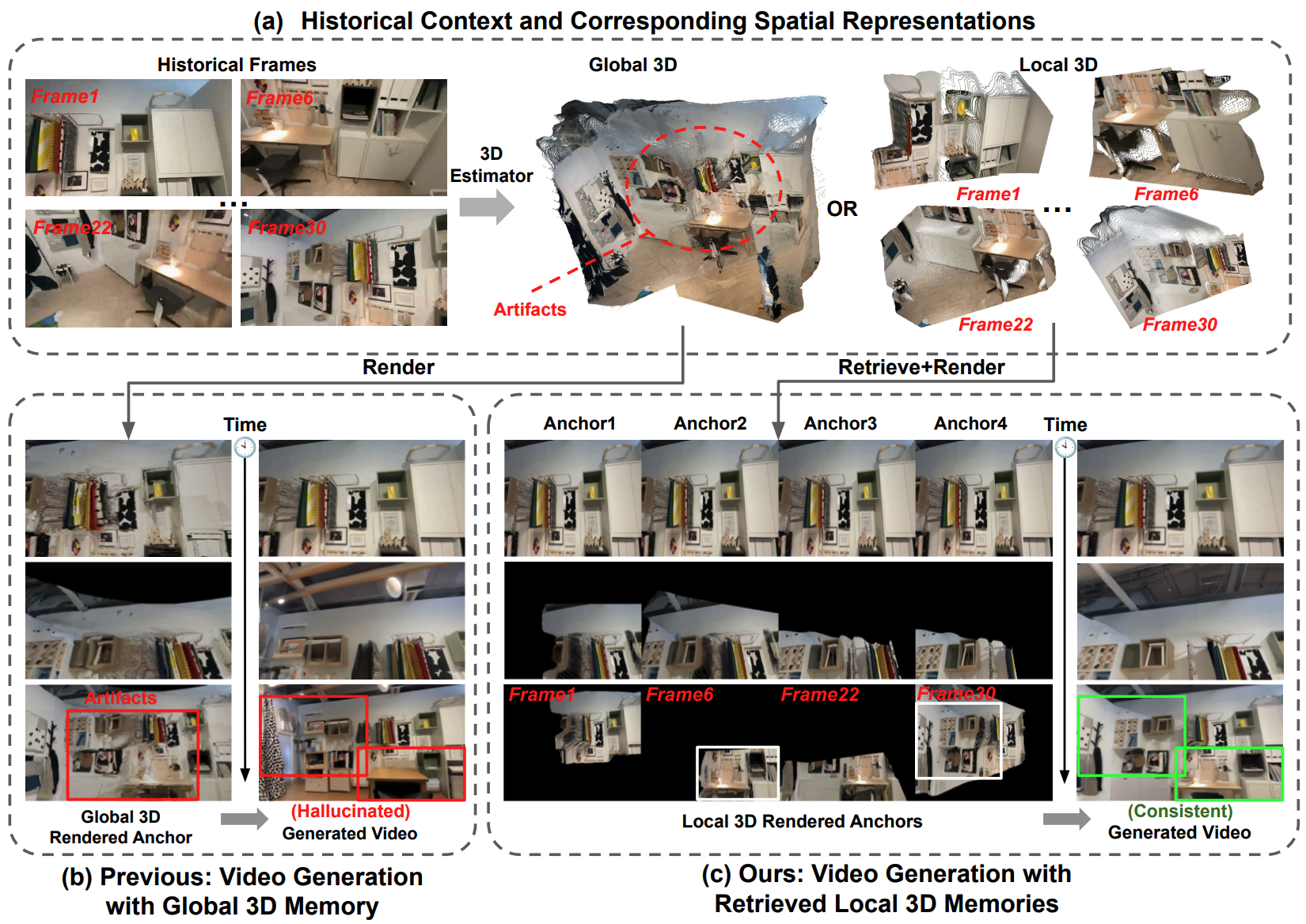
Motivation: Global 3D vs Local 3D


Method

Global 3D reconstruction accumulates cross-view misalignment, introducing artifacts in the reconstructed geometry ((a), middle), which propagate to the generated video as hallucinations ((b), red boxes). In contrast, per-frame local geometry inherently avoids cross-view misalignment and therefore remains clean ((a), right). Conditioning on multiple retrieved local geometric anchors, AnchorWeave maintains strong spatial consistency with the historical frames ((c), white and green boxes).

Coverage-driven memory retrieval pipeline
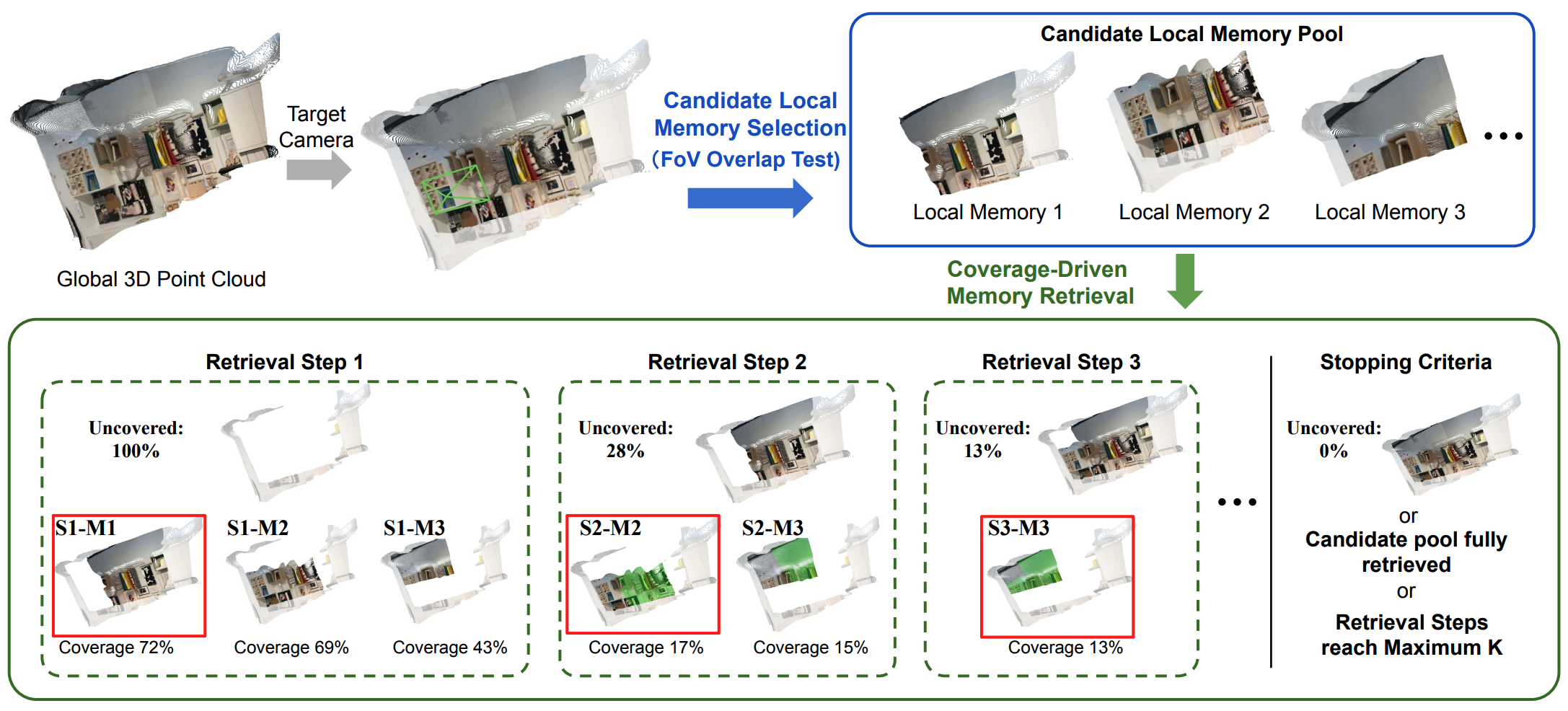

Coverage-driven retrieval

Given a target camera, we first select local memories whose camera FoVs partially overlap with the target camera view to form a candidate memory pool. At each retrieval step, we greedily select the memory that maximizes the newly covered visible area. Points invisible to the target camera are shown in gray. Si–Mj denotes memory j selected at retrieval step i, and the red box indicates the retrieved memory. In Si-Mj, regions already covered by previously retrieved memories are highlighted in green and only newly covered regions retain their original RGB colors. No green regions appear in S1-Mj since 1st-step's coverage is empty. Retrieval terminates when the uncovered region is 0%, the retrieval budget K is exhausted, or the remaining memory pool is empty. For clarity, coverage is computed with a single frame here, while in practice is aggregated over multiple frames per chunk.

Architecture of multi-anchor weaving controller
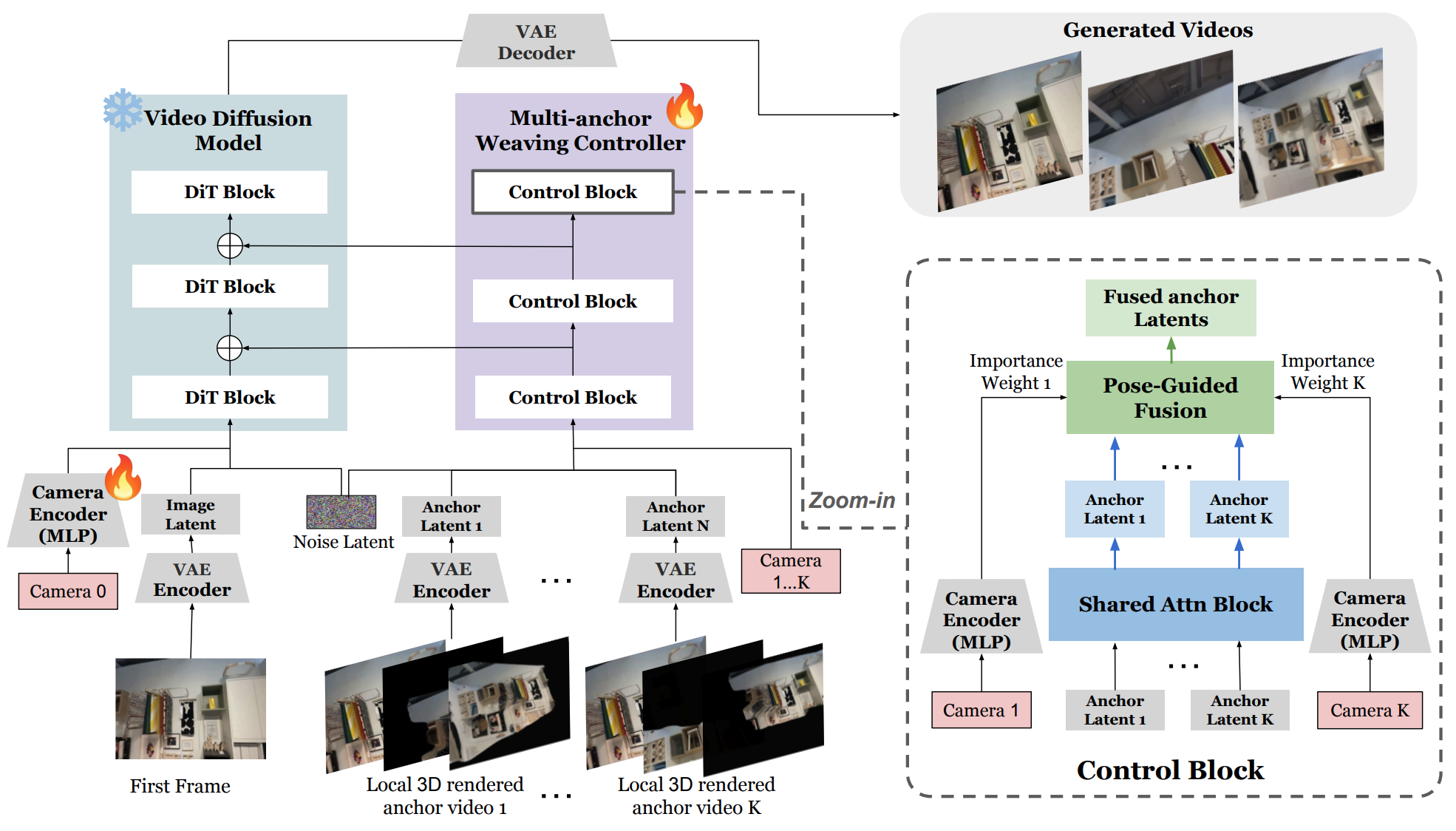

Multi-anchor weaving controller

Anchors are encoded and jointly processed by a shared attention block, followed by camera-pose-guided fusion to produce a unified control signal injected into the backbone model. Camera 1 to K represent the retrieved-to-target camera poses for the 1 to K anchor videos, where each denotes the relative pose between the camera associated with a retrieved local point cloud and the target camera, measuring their viewpoint proximity. Camera 0 is the relative target camera trajectory.
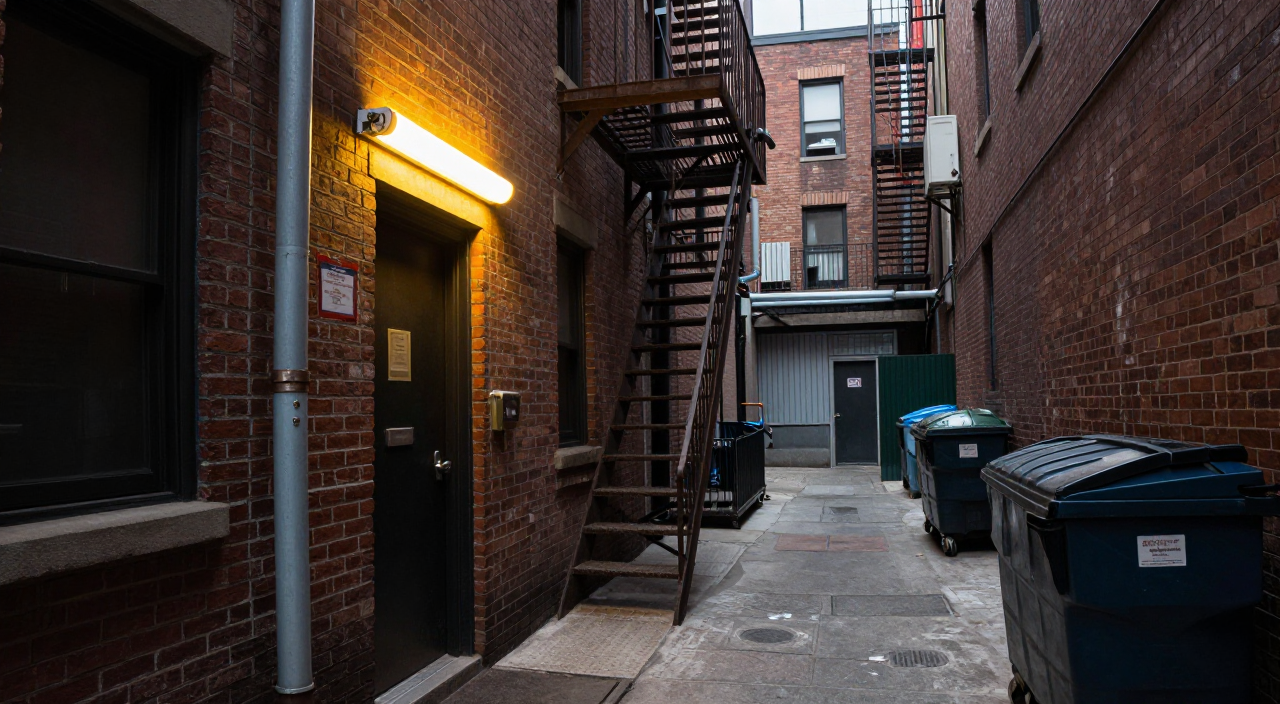

AnchorWeave Generation Visualization


Historical Context (left) vs. Generation Condition and Results (right).

Comparison


Comparison with Previous Methods


Qualitative comparison with baseline methods under the revisit setting. Gen3C, TrajCrafter, ViewCrafter, are single-anchor-based methods, we use the 1st retrieved anchor video as their memory; Context-as-Memory and SEVA directly condition on multi-view history images; SPMem condition on global point cloud renderings and keyframes. Blur and artifacts are observed in single-anchor methods, ViewCrafter and SPMem has hallucinations issues, SEVA misses details and Context-as-Memory's camera controllability is not good. In contrast, AnchorWeave (Ours) keeps scene structure more consistent via dense local memory conditioning.

Citation

@article{wang2025anchorweave,
  title={AnchorWeave: World-Consistent Video Generation with Retrieved Local Spatial Memories},
  author={Wang, Zun and Lin, Han and Yoon, Jaehong and Cho, Jaemin and Zhang, Yue and Bansal, Mohit},
  journal={arXiv preprint},
  year={2025}
}